Open vs Enclosed 3D Printer: Do You Need an Enclosure?
Open or enclosed 3D printer? If you print PLA, open is fine. When an enclosure helps (ABS, ASA, kids, pets, drafts), what it does not fix (fumes), and which printers fit each case.
DisclosureWe may earn a commission when you buy through links on this site, at no extra cost to you. As an Amazon Associate we earn from qualifying purchases.
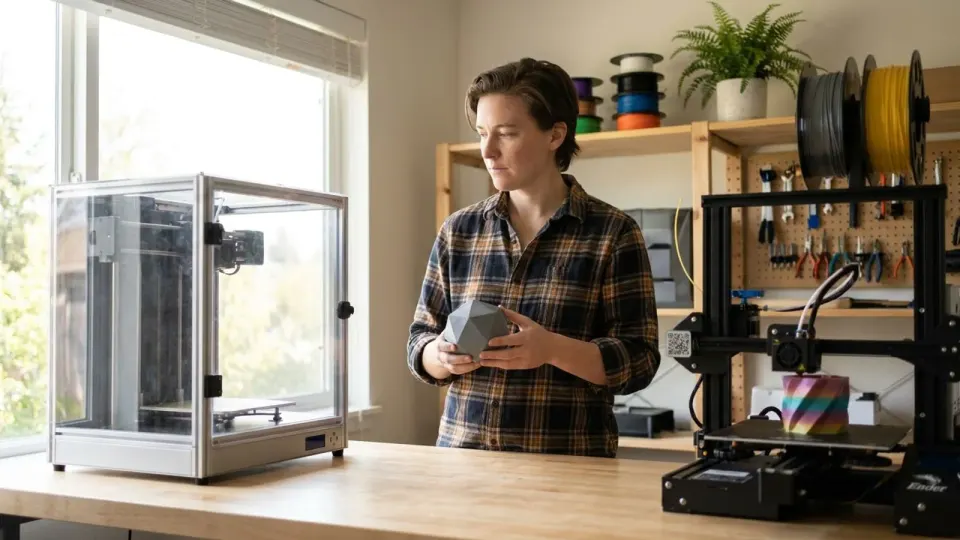
If you’ll print mostly PLA, you don’t need an enclosed 3D printer. PLA prints well on open printers, and on enclosed printers many owners open the door or lid for it, because Bambu Lab’s wiki links heat buildup in the chamber to clogs. Choose enclosed if you want to print ABS or ASA (they warp in drafts), if kids or pets can reach the printer (the door keeps hands off the hot nozzle), or if the room is drafty or dusty. An enclosure does not make fumes disappear: NIOSH research shows that only a fully sealed enclosure with filtered exhaust captures particles reliably. Our enclosed picks are in the best 3D printer for teens.
Open vs enclosed at a glance
| Open-frame printer | Enclosed printer | |
|---|---|---|
| PLA | Ideal | Fine; follow the manual on opening the door or lid |
| PETG, TPU | Fine | Fine |
| ABS, ASA | Not recommended by most makers | What they’re made for |
| Hot parts within reach | Yes | Behind a door |
| Drafts and room temperature swings | Affect the print | Mostly kept out |
| Fumes and particles | Go straight into the room | Contained only if the enclosure is sealed and filtered or vented |
| Noise | Nothing in the way | Panels can damp some noise |
| Footprint | Smaller for the same build size | Bigger, heavier box |
| Example (maker specs) | Bambu Lab A1 mini: 180 mm cube | Elegoo Centauri Carbon 2: 256 mm cube, HEPA + carbon filter |
Do I need an enclosed 3D printer?
Work through these four questions.
1. What will you print?
This is the big one. PLA is the beginner filament, and it doesn’t need an enclosure. PETG and TPU print fine on open printers too; Bambu lists PLA, PETG, TPU and PVA as ideal materials for the open-frame A1 mini.
ABS and ASA are different. They shrink as they cool, so drafts and a cold room pull corners off the bed (warping) and can split layers. That’s why Bambu lists ABS, ASA, PC and PA as not recommended on the A1 mini, while enclosed printers like the Elegoo Centauri Carbon 2 list ABS and ASA as supported. If you know you’ll want ABS or ASA for car parts, outdoor parts or anything that sits in the sun, buy enclosed from the start. Our PLA vs PETG guide covers which material fits which job.
2. Who else is in the house?
Every FDM printer has a nozzle at a couple of hundred degrees, a heated bed and fast-moving parts. Bambu’s A1 mini safety notes tell users not to touch the nozzle or bed while printing, and Elegoo’s manual for the Centauri Carbon 2 says the same. On an enclosed printer, a door sits between those parts and curious hands or paws. With young kids or pets, enclosed is the safer default. See the best 3D printer for teens and kids for parent-first picks.
3. Where will it live?
A drafty room, an AC vent or a cold garage can hurt prints even with PLA and PETG. An enclosure (or a tent around an open printer) blocks drafts and keeps dust off. If the printer sits in a living space, consider noise too: makers list figures like under 45 dB for the Centauri Carbon 2 in Elegoo’s own silent-mode test, and 50 dB in low-noise mode for the Flashforge Adventurer 5M Pro. Makers measure differently, so treat these as rough guides.
4. How much space do you have?
Enclosed printers are bigger and heavier for the same build volume. Bambu lists the open A1 mini at 347 x 315 x 365 mm and 5.5 kg. An enclosed CoreXY printer with a 256 mm build cube needs a solid table and noticeably more room.
What an enclosure does not fix: fumes
This is the part most “open vs enclosed” pages skip. Melting plastic releases ultrafine particles and organic chemicals. An enclosure only helps with that if it actually captures the air and sends it through a filter or outdoors.
- A 2026 NIOSH study (O’Connor, Barnes, Dunn and Hammond, Atmospheric Environment: X) tested low-cost controls. A commercial, printer-specific partial enclosure captured as little as 28.6% of particles, because the printer’s own cooling fans pushed emissions out. A full acrylic enclosure connected to a filtration unit captured at least 99.8%.
- A NIOSH Science Blog post on 3D printing in an office lists ventilation as a key control, including enclosed racks that vent outdoors and local exhaust connections.
So a door alone isn’t a fume solution. If you care about air quality, look for an enclosed printer with built-in filtration (Elegoo lists HEPA plus activated carbon on the Centauri Carbon 2; Flashforge lists a dual-layer filter on the Adventurer 5M Pro; QIDI lists a 3-in-1 filtration system on the Q2), keep the door closed while printing, and still put the printer in a ventilated room, away from where anyone sleeps. Elegoo’s manual says to run the Centauri Carbon 2 in a well-ventilated area, even with its filter.
Enclosed 3D printer for PLA: is it a problem?
Not a problem, but it needs a little care. PLA softens at low temperatures (Bambu lists a 54 °C heat deflection temperature for PLA Basic), and heat that builds up inside a closed chamber can soften filament in the extruder before it reaches the nozzle. Bambu’s wiki names heat buildup inside the enclosure and heat creep as the most common reason for clogs on its enclosed X1 Carbon and P1S printers. That’s why many owners print PLA with the door open or the lid raised, and why some enclosed printers manage chamber airflow automatically (Elegoo lists an auto-controlled grille on the Centauri Carbon 2). Follow your printer’s manual for PLA.
3D printer enclosure for ABS: tent or enclosed printer?
You have two routes:
- Buy an enclosed printer. Simplest. The enclosure, the filter and the printer are designed together. Some, like the QIDI Q2, add active chamber heating (up to 65 °C per QIDI), which helps larger ABS and ASA parts.
- Put an open printer in a tent. Cheaper if you already own a printer. A tent blocks drafts and holds some warmth, but most tents aren’t sealed, and the NIOSH study above shows how poorly partial enclosures capture particles. If you go this way, pick a tent with a vent port and run a duct to a window. Our best 3D printer enclosure roundup covers tents with maker sizes.
Check the printer maker first. Some open printers aren’t meant to be enclosed at all: a Bambu Lab support post says it doesn’t recommend putting the A1 in an enclosure, especially a heated one, because the mainboard and power supply in the base can overheat. And Bambu doesn’t recommend ABS or ASA on the A1 mini anyway.
Printers for each case
Open and compact: Bambu Lab A1 mini
Bambu Lab A1 mini
A compact open-frame FDM printer with a 180 mm build cube, made for PLA, PETG and TPU. Bambu also sells it as a Combo with the four-spool AMS lite for multicolor prints.
- Type
- Open-frame bed-slinger FDM printer
- Build volume
- 180 x 180 x 180 mm
- Max hotend temperature
- 300 °C
Bambu lists a 180 mm build cube, PLA, PETG and TPU as ideal materials, and the four-spool AMS lite as an option. A good fit for PLA-first printing on a small desk, if nobody young can reach it. Compare it in Ender-3 V3 SE vs A1 mini and A1 mini vs Centauri Carbon 2.
Enclosed all-rounder: Elegoo Centauri Carbon 2
Elegoo Centauri Carbon 2
An enclosed CoreXY FDM printer with a 256 mm build cube, a 350 °C hardened steel nozzle and a built-in camera. Ready for Elegoo's four-color CANVAS system (included in the Combo, sold separately otherwise).
- Type
- Enclosed CoreXY FDM printer
- Build volume
- 256 x 256 x 256 mm
- Max nozzle temperature
- 350 °C (hardened steel nozzle)
Elegoo lists an enclosed chamber with a glass door, a 256 mm build cube, a 350 °C hardened steel nozzle, a 110 °C bed, a HEPA plus activated carbon filter and support for ABS, ASA and some carbon-fiber blends.
Small enclosed printer: Flashforge Adventurer 5M Pro
Flashforge Adventurer 5M Pro
A compact enclosed printer with a 220 mm build cube, a filtration system and a low-noise mode. A smaller footprint than most enclosed picks.
- Type
- Enclosed CoreXY FDM printer
- Build volume
- 220 x 220 x 220 mm
- Max nozzle temperature
- 280 °C
A 220 mm build cube in an enclosed body, with a dual-layer filter system and a low-noise mode (50 dB per Flashforge). Flashforge lists a 280 °C nozzle, so check its material list before planning engineering filaments.
Enclosed with chamber heating: QIDI Q2
QIDI Q2
An enclosed CoreXY printer with a 270 x 270 x 256 mm build volume, active chamber heating and an AI camera. Built for engineering materials, which also makes it a printer a teen won't outgrow.
- Type
- Enclosed CoreXY FDM printer
- Build volume
- 270 x 270 x 256 mm
- Max nozzle temperature
- 370 °C (bimetal hardened steel nozzle)
QIDI lists a 270 x 270 x 256 mm build volume, active chamber heating up to 65 °C, a 370 °C nozzle and 3-in-1 filtration. It’s the most capable ABS and ASA option here. See our QIDI Q2 review for the full spec rundown.
FAQ
Do I need an enclosed 3D printer for PLA? No. PLA prints well on open printers. On an enclosed printer, follow the manual; many owners open the door or lid for PLA to avoid heat creep.
Is an enclosed 3D printer safer? For hot parts and moving parts, yes: the door keeps hands away. For fumes, only partly. Look for built-in filtration, keep the door closed while printing and ventilate the room.
Can I print ABS on an open printer? Some people do, but drafts make warping and layer splits likely, and many makers don’t recommend it. Bambu lists ABS and ASA as not recommended on the A1 mini. Use an enclosed printer for ABS and ASA.
Does an enclosure reduce 3D printer noise? Panels can damp some noise, and makers of enclosed printers list quiet modes, but fans still run. Compare the makers’ noise figures, keeping in mind they measure differently.
Can I add an enclosure to an open printer later? Yes, with a tent or a DIY box, but check the printer maker’s guidance first. Bambu’s support team advises against enclosing the A1 series because the electronics in the base can overheat. See best 3D printer enclosure.
Is PETG OK in an open printer? Yes. Bambu lists PETG as ideal for the open A1 mini. PETG does need drying more than PLA; see the best filament dryer.
Bottom line
Start with your material. PLA-only with no small kids around: an open printer like the A1 mini is all you need. ABS or ASA later, kids or pets, or a drafty room: buy enclosed, ideally with a built-in filter, and still ventilate. Our best 3D printer for teens and beginners lists the enclosed picks, and PLA vs PETG for beginners helps you choose your first spools.
Sources
- O’Connor C, Barnes C, Dunn KL, Hammond DR: “Design and Evaluation of Four Low-Cost Engineering Controls for Reducing Particle Emissions from 3D Printing”, Atmospheric Environment: X 30 (2026), 100432 (stacks.cdc.gov/view/cdc/258855)
- NIOSH Science Blog: “Characterizing 3D Printing Emissions and Controls in an Office Environment” (August 2018, cdc.gov/niosh)
- NIOSH: Approaches to Safe 3D Printing (publication 2024-103, cdc.gov/niosh)
- Bambu Lab A1 mini tech specs (bambulab.com), A1 mini FAQ and safety notes, heat creep article, PLA Basic data sheet (wiki.bambulab.com, bambulab.com)
- Bambu Lab forum: support reply on enclosing the A1 (forum.bambulab.com)
- Elegoo Centauri Carbon 2 product pages and manual (elegoo.com)
- Flashforge Adventurer 5M Pro product page (flashforge.com)
- QIDI Q2 product page (qidi3d.com)